

Are you looking to build a sustainable stream of passive income? Dividend investing offers a compelling pathway to financial freedom, allowing you to generate cash flow from your investments. This comprehensive guide, “Understanding Dividend Investing: How to Build Passive Income,” will equip you with the knowledge and strategies to successfully navigate the world of dividend stocks, helping you understand how to select high-yielding companies, manage risk, and ultimately build a robust portfolio that generates consistent returns and secures your financial future. Learn how to harness the power of dividend reinvestment and optimize your investment strategy for long-term growth.
What is Dividend Investing and How Does It Work?

Dividend investing involves purchasing shares of stocks in companies that pay out a portion of their profits to shareholders as dividends. This is a form of passive income, meaning you earn money even without actively working.
How it works: Companies that are financially healthy and profitable often choose to distribute some of their earnings to shareholders as a reward for their investment. These dividends are typically paid out on a quarterly basis, although some companies may pay out more or less frequently.
The amount of the dividend is determined by the company’s board of directors and is usually expressed as a dollar amount per share or as a percentage of the share price. To receive dividends, you must own the shares of stock before the ex-dividend date. The ex-dividend date is the date before which you must own shares to be eligible for the upcoming dividend payment.
Dividend investing is a long-term strategy that aims to generate a consistent stream of income from your investments. It requires careful selection of companies with a history of paying consistent and growing dividends, as well as an understanding of the risks involved in the stock market.
The Benefits of Dividend Stocks for Long-Term Growth
Dividend stocks offer a compelling strategy for long-term growth by providing passive income alongside capital appreciation. The regular dividend payments generate a steady stream of cash flow, allowing investors to reinvest dividends for further growth or use them for other financial needs.
Compounding returns is a key advantage. Reinvesting dividends allows you to buy more shares, increasing your ownership and future dividend payments. This snowball effect significantly enhances long-term returns, outpacing strategies focused solely on capital appreciation.
Reduced volatility is another benefit. Dividend-paying companies often exhibit greater stability compared to growth stocks, leading to a smoother investment journey. This stability can be particularly valuable during market downturns.
Higher overall returns are often observed with dividend stocks over extended periods. While not guaranteed, the combination of dividend income and price appreciation can generate superior returns compared to non-dividend paying stocks.
Portfolio diversification is easily achieved by including dividend stocks in your investment portfolio. They offer a different risk profile than growth stocks, potentially mitigating overall portfolio volatility and enhancing long-term performance.
How to Choose the Best Dividend Stocks

Selecting the best dividend stocks requires a multi-faceted approach. Prioritize financial strength by examining key metrics like the debt-to-equity ratio and return on equity (ROE). A company with low debt and high ROE suggests strong financial health and sustainability of dividend payments.
Analyze dividend history. Look for companies with a consistent history of dividend payments, ideally increasing over time. This demonstrates the company’s commitment to returning value to shareholders. Consider the dividend payout ratio, which shows the percentage of earnings paid out as dividends. A sustainable payout ratio generally lies between 30% and 70%, although this can vary by industry.
Assess the company’s future prospects. A company’s ability to maintain and grow its dividend depends on its future earnings potential. Research the company’s industry, competitive landscape, and growth opportunities. Look for companies with a strong competitive advantage and a clear path to future growth.
Diversify your portfolio. Don’t put all your eggs in one basket. Investing in a diversified portfolio of dividend stocks across different sectors reduces your overall risk. This mitigates the impact if one company’s performance falters.
Finally, remember that past performance is not indicative of future results. While historical dividend data is helpful, thorough due diligence is crucial before investing in any dividend stock.
The Importance of Dividend Yield and Payout Ratio
Understanding dividend yield and payout ratio is crucial for successful dividend investing. Dividend yield represents the annual dividend per share relative to the share price, indicating the return on investment from dividends alone. A higher yield suggests a potentially greater return, but it’s essential to consider the underlying factors contributing to this yield.
The payout ratio, on the other hand, shows the proportion of a company’s earnings paid out as dividends. A high payout ratio might signal a generous dividend policy, but it could also indicate a lack of reinvestment opportunities for growth, potentially impacting future dividend sustainability. Conversely, a low payout ratio might suggest strong growth potential but potentially lower immediate dividend income.
Analyzing both metrics together provides a more comprehensive picture. A high yield coupled with a sustainable payout ratio (meaning it’s not excessively high compared to earnings and is likely to be maintained) is generally a favorable combination. However, always investigate the company’s financial health and future prospects before investing based solely on these ratios.
How to Reinvest Dividends for Compounded Returns
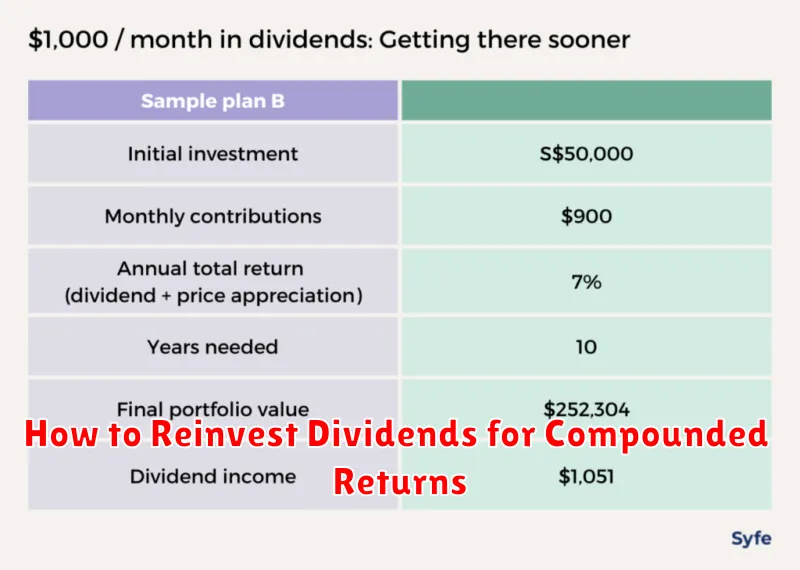
Reinvesting dividends is a crucial strategy for maximizing returns in dividend investing. Instead of receiving dividend payments as cash, you instruct your brokerage to automatically purchase additional shares of the same stock with those dividends. This seemingly small action significantly impacts your long-term growth.
Compounding is the magic behind this strategy. Your reinvested dividends generate more dividends, which in turn buy more shares, leading to an exponential increase in your holdings over time. The earlier you start reinvesting, the greater the benefit of compounding.
How to do it: Most brokerages offer a simple way to set up automatic dividend reinvestment (DRIP). Check your brokerage account settings to find the option to automatically reinvest dividends. You might need to activate this feature for each individual stock.
Benefits: Reinvesting dividends accelerates wealth building through the power of compounding. It allows you to buy more shares without requiring additional capital from your pocket, thereby increasing your overall returns exponentially over the long term. This consistent, passive growth is a core element of building significant passive income.
Considerations: While beneficial, reinvesting dividends may not be optimal in every situation. Consider your individual financial goals and risk tolerance. If you need the dividend income for immediate expenses, reinvesting might not be suitable.
Dividend ETFs vs Individual Stocks: Which is Better?
Choosing between dividend ETFs and individual dividend stocks depends on your investment goals and risk tolerance. Dividend ETFs offer diversification, lower management fees, and ease of investing. They provide exposure to a basket of dividend-paying companies, reducing the risk associated with investing in a single stock. However, returns may be lower than individual high-performing stocks.
Individual dividend stocks, on the other hand, offer the potential for higher returns if you select winning companies. However, they carry significantly higher risk. Thorough research and due diligence are crucial, as a poor selection can lead to substantial losses. Management of a portfolio of individual stocks also requires more time and expertise.
Ultimately, the “better” option is subjective. Beginners or those seeking a less hands-on approach might prefer the simplicity and diversification of ETFs. Experienced investors comfortable with higher risk and willing to dedicate time to research might find individual stocks more rewarding. Consider your investment timeline, risk tolerance, and available resources when making your decision.
Tax Implications of Dividend Investing
Dividends, while offering a steady stream of passive income, are subject to taxation. The tax rate applied to dividend income varies depending on your tax bracket and the type of dividend received (qualified or non-qualified). Qualified dividends, generally from U.S. corporations, often receive a lower tax rate than ordinary income. Non-qualified dividends, however, are taxed at your ordinary income tax rate.
It is crucial to understand your individual tax situation to accurately determine the tax liability on your dividend income. Factors such as your filing status and total taxable income influence the overall tax burden. Consulting with a tax professional is recommended for personalized advice.
Proper tax planning is vital to maximizing your after-tax returns from dividend investing. Strategies such as holding dividend-paying stocks in a tax-advantaged account, like a Roth IRA or 401(k), can significantly reduce your tax liability. Understanding the tax implications allows for informed investment decisions and optimal wealth management.
Building a Diversified Dividend Portfolio for Passive Income
Building a diversified dividend portfolio is crucial for generating consistent passive income. Diversification minimizes risk by spreading investments across various sectors and companies. This reduces the impact of a single company’s underperformance on your overall returns.
Start by identifying high-quality dividend-paying companies with a history of consistent dividend payouts and growth. Consider factors like payout ratio, dividend yield, and financial stability. Look beyond just the yield; a lower yield from a financially strong company may be preferable to a high yield from a risky one.
Sector diversification is key. Don’t put all your eggs in one basket. Invest in different sectors like technology, healthcare, consumer staples, and financials. This helps to mitigate risk associated with economic downturns affecting specific industries.
Consider using different investment vehicles such as individual stocks, ETFs (Exchange Traded Funds), or mutual funds specializing in dividend-paying stocks. ETFs and mutual funds offer instant diversification, simplifying the process.
Regularly rebalance your portfolio. As your investments grow, some sectors might outperform others, shifting the allocation from your initial target. Rebalancing ensures your portfolio maintains the desired level of diversification.
Finally, monitor your portfolio’s performance. Track your dividend income and the overall growth of your investments. Adjust your strategy as needed based on market conditions and your financial goals.
